


Views: 0 Author: Site Editor Publish Time: 2026-09-11 Origin: Site


The solar industry has definitively phased out smaller formats like 156mm and 166mm. Large-format modules are now the undisputed standard for new installations globally. Project developers and EPCs face a crucial binary choice today. You must choose between 182mm (M10) or 210mm (G12) architectures for your portfolio. Selecting the wrong format leads to severe inverter incompatibility. It can also cause unexpected spikes in Balance of System (BOS) expenses and create frustrating logistical bottlenecks.
We provide an evidence-based framework in this guide. You will learn exactly how to evaluate 182mm vs 210mm solar cells based on system compatibility, structural risks, and Levelized Cost of Energy (LCOE) outcomes. Our goal is to help you navigate modern module selection confidently. You will discover practical ways to match wafer sizes directly to your specific site requirements, ensuring your next solar project performs flawlessly.
Market Dominance: Both 182mm and 210mm account for the vast majority of current global module shipments, but they serve different optimal use cases.
182mm (M10) Advantage: Offers the "sweet spot" for standardization, presenting fewer risks regarding inverter current limits, manual handling, and shipping container utilization.
210mm (G12) Advantage: Maximizes power output per module, significantly reducing string counts and mechanical mounting costs for utility-scale deployments.
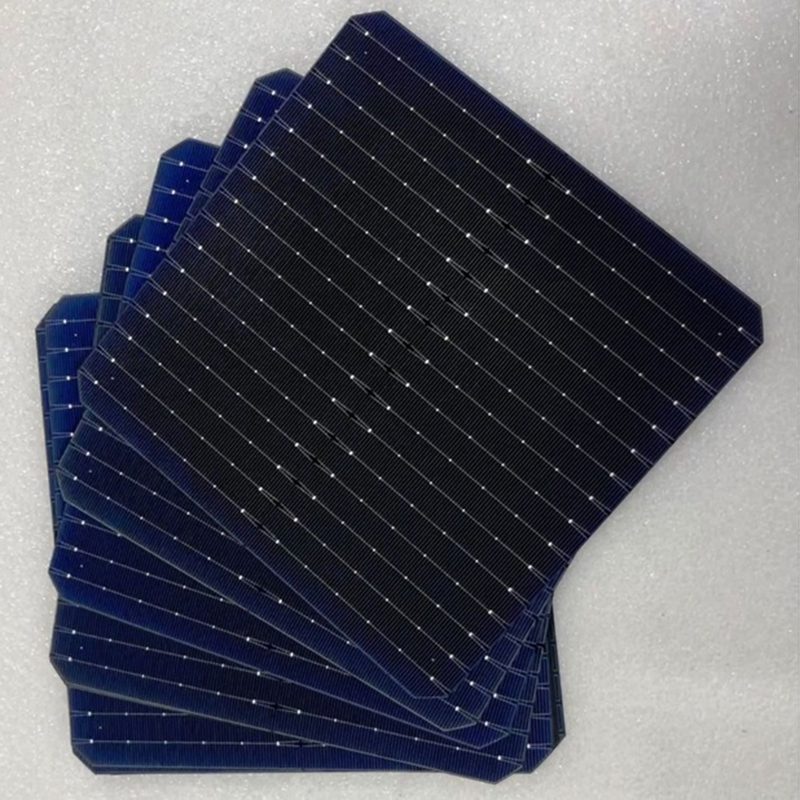
The Tech Overlay: Transitioning from an M10 PERC Solar Cell to an M10 TOPCon Solar Cell allows developers to achieve high power classes without upgrading to the larger 210mm physical footprint.
The entire photovoltaic supply chain pivoted to larger wafers to capture economies of scale. Manufacturers realized they could produce more wattage per wafer pull. Project developers wanted higher power density per panel to reduce overall installation labor. This mutual desire pushed the industry away from legacy sizes toward two dominant formats.
The 182mm (M10) format emerged as a standardized size prioritizing balanced electrical parameters. It maintains excellent compatibility across existing supply chains. Engineers designed the M10 specifically to fit perfectly inside standard shipping containers. It also keeps module weights manageable for standard rooftop installation crews.
In contrast, the 210mm (G12) format represents the largest commercially viable wafer today. Manufacturers designed it to push module power well beyond the 600W threshold. This massive size radically changes system design, catering heavily to utility-scale ground-mount projects.
Recently, the industry introduced a clever hybrid solution. The G12R Solar Cell utilizes a rectangular geometry (210mm x 182mm). This format acts as a strategic compromise. It leverages existing 210mm manufacturing lines while keeping the module width narrow enough to maximize standard shipping container packing density.
You cannot evaluate cell sizes without understanding their fundamental electrical behavior. The two sizes dictate entirely different current and voltage profiles for the finished module.
A 182mm module generally features a lower operating current and a higher voltage profile. Conversely, a standard G12 Solar Cell inherently produces a high-current, low-voltage profile. When you increase the physical area of the cell, the current generated goes up proportionally. High current directly impacts thermal losses. If you do not size wiring gauges appropriately, the increased current of a 210mm system will generate excess heat and reduce overall efficiency.
Common Mistake: Project designers sometimes use the same wiring gauge for 210mm modules as they did for older 166mm modules. This leads to unacceptable DC voltage drop and potential overheating at connector junctions.
N-type cell architectures fundamentally change the size debate. Previously, developers felt forced to buy 210mm modules just to hit high wattage classes. High-efficiency cell technology shifted this dynamic.
Specifying an M10 TOPCon Solar Cell bridges the power gap previously held by older, larger PERC modules. By upgrading from a traditional M10 PERC Solar Cell, you gain significant efficiency improvements. You can achieve utility-scale power output while maintaining a more manageable physical footprint. N-type efficiency gains mean you no longer have to compromise on ergonomics just to get higher yield.
Standard Electrical Parameter Comparison
Cell Type | Dimensions (mm) | Typical Operating Current (Imp) | Typical Operating Voltage (Vmp) | Optimal Application |
|---|---|---|---|---|
M10 (182mm) | 182 x 182 | 13A - 14A | High | C&I, Residential, General Ground Mount |
G12 (210mm) | 210 x 210 | 17A - 18A+ | Low | Utility-Scale, Tracker Systems |
G12R (Rectangular) | 210 x 182 | 14A - 15A | Moderate | Optimized Utility-Scale & Logistics |
Cell size dictates module dimensions. Module dimensions subsequently dictate your entire system design. You must evaluate features directly against financial outcomes to determine true savings.
Utility developers favor 210mm modules because they drastically reduce the total number of panels needed per megawatt. Handling fewer panels directly lowers racking material usage. Your crews drive fewer piles and install fewer tracker tubes. Labor costs drop because workers spend less time mounting and clamping.
Cabling presents another massive savings opportunity. The lower voltage of 210mm cells allows you to connect more modules in a single string before hitting the 1500V system limit. Longer strings mean you need fewer combiner boxes. You also use substantially less home-run cabling back to the inverter.
We must acknowledge transparent assumptions here. While 210mm modules look much better on paper for LCOE, the actual BOS savings depend highly on site topography. If your site features severe undulating terrain, massive 210mm modules on long tracker tables become difficult to align. Fixed-tilt systems on steep slopes may actually favor the slightly smaller M10 form factor to maintain structural compliance and ease of installation.
System Design Impact Chart
Design Factor | 182mm (M10) Impact | 210mm (G12) Impact |
|---|---|---|
Modules per MW | Higher | Lower (Fewer units to handle) |
String Length (Modules) | Shorter (Hits voltage limit faster) | Longer (More capacity per string) |
DC Cabling Required | Standard | Reduced |
Terrain Adaptability | High (Easier to step and stagger) | Moderate (Requires flatter runs) |
Connecting high-power 210mm modules to legacy or mismatched inverters represents the core implementation risk for developers today. You cannot simply swap an older module out and drop a new 210mm module in its place.
The primary issue involves Maximum Power Point Tracking (MPPT) current limits. G12 formats often require inverters capable of handling 18A to 20A or more per string. If you connect these high-current panels to an older inverter capped at 15A, the inverter will aggressively clip the excess current. Current clipping destroys your yield expectations. Worse, continuous overcurrent operation can void warranties or trigger hardware failures.
Conversely, 182mm modules generally operate safely within a much more standard 13A to 15A limit. This makes them highly compatible with nearly all modern and legacy string inverters.
Best Practice: Always audit the Short Circuit Current (Isc) of your chosen module against the Maximum Input Current per MPPT on your inverter datasheet. Factor in temperature coefficients, as cold weather pushes current higher.
Compliance and safety also require strict attention. High-current G12 systems inherently run at higher operating temperatures at the connection points. You must carefully calculate DC fuse sizing. Standard 20A fuses might blow prematurely under edge-of-cloud high-irradiance conditions when using 210mm modules. You will likely need to upgrade to 25A or 30A fuses to ensure safe, uninterrupted operation.
Transportation and handling costs heavily influence procurement decisions. The physical dimensions of the module dictate how many watts you can stuff into a shipping container.
Manufacturers explicitly optimized 182mm and G12R modules to maximize packaging density in standard 40-foot High Cube (HC) shipping containers. They fit perfectly two pallets high. This spatial efficiency significantly reduces overseas freight costs. The larger 210mm modules push container dimensions to their absolute limit. They sometimes require specialized pallet configurations that increase loading and unloading complexity.
We must also examine the mechanical risks of ultra-large modules. Massive 210mm surface areas act like sails under severe wind loads. They also collect substantial snow. Extreme deflection can cause micro-cracking inside the cells. To prevent this, manufacturers often mandate dual-glass configurations or utilize thicker aluminum frames for 210mm formats. These additions protect structural integrity but increase the total module weight.
Wind Load Assessment: Always run site-specific wind modeling. Large modules bow significantly more than smaller ones.
Frame Thickness Check: Reject 210mm modules featuring frames thinner than 30mm for high-wind areas.
Mounting Point Verification: Ensure your racking system supports the exact clamping zones mandated by the manufacturer.
Installer ergonomics present a stark reality on the ground. A single 210mm panel often crosses the weight and size threshold of what two workers can safely handle. Maneuvering a 35kg, 2.3-meter-long panel on a pitched commercial roof exhausts crews quickly. The 182mm format remains the sensible maximum for manual, non-mechanized roof installations.
You need a clear decision matrix to navigate procurement correctly. Apply these criteria to your next project portfolio.
The M10 format shines in environments where standardization and flexibility remain paramount. You should specify 182mm cells for:
Commercial and Industrial (C&I) Rooftops: Smaller footprints allow for better obstacle avoidance on crowded roofs. Installers can manually hoist and carry them safely.
Retrofit Projects: Sites utilizing existing or older inverter architectures usually cannot handle G12 current profiles. The M10 offers a safe, plug-and-play upgrade path.
Extreme Weather Environments: Projects facing high wind or snow loads benefit from the maximum mechanical rigidity of a slightly smaller surface area.
The G12 format dominates scenarios where raw scale drives profitability. You should specify 210mm cells for:
Utility-Scale Ground-Mount Projects: Massive open spaces allow developers to leverage the lower BOS costs of large formats.
Single-Axis Trackers: Modern trackers are explicitly optimized to hold fewer, larger modules, maximizing land utilization.
Low-Margin EPC Contracts: Projects where lowering the string count and reducing mechanical racking hardware is the primary path to EPC profitability.
Neither 182mm nor 210mm cell sizes are objectively "better" in a vacuum. The right choice depends entirely on evaluating your potential BOS savings against strict integration risks. Pushing for the highest wattage module will backfire if your site terrain is complex or your inverters cannot handle the current.
Before finalizing your procurement contract, require detailed string sizing calculations from your engineering team. Always request inverter compatibility letters from the module manufacturer. Finally, demand third-party wind-load and snow-load testing reports tailored to the exact frame thickness you intend to buy. Matching the module format to your site's physical and electrical realities guarantees long-term project success.
A: Yes. The industry has definitively phased out 156mm and 166mm formats. Manufacturers retooled their production lines for larger wafers to achieve better economies of scale. Replacing damaged 166mm panels today generally requires moving to 182mm modules, which may involve redesigning string layouts to account for different dimensions.
A: Usually not without careful verification. 210mm modules produce a much higher short-circuit current (Isc), often exceeding 18A. Many older string inverters have Maximum Power Point Tracking (MPPT) limits around 15A. Using a 210mm module on a 15A inverter causes severe current clipping and potential damage. 182mm modules fit legacy inverters much better.
A: A standard G12 cell uses a square 210mm x 210mm geometry, creating very wide, high-power modules. The G12R is a rectangular 210mm x 182mm cell. The G12R reduces the overall width of the finished module, allowing it to pack much more efficiently into standard shipping containers while maintaining high power output.
A: No. Physical size dictates total power output (wattage), but not the conversion efficiency percentage. A massive panel produces more watts simply because it has more surface area. True efficiency increases come from underlying cell architecture, such as moving from traditional PERC technology to advanced TOPCon or Heterojunction (HJT) designs.



