


Views: 0 Author: Site Editor Publish Time: 2026-07-05 Origin: Site


Let us get straight to the facts. You look at your roof after sunset. Do those shiny modules still produce electricity? The literal answer is no. A Solar Panel does not generate electricity at night. We must skip the industry fluff entirely. "Not generating power" rarely means your house goes dark. A smartly designed system guarantees seamless electricity while you sleep. Your real challenge involves choosing how you manage nighttime energy consumption. Powering a home after dusk means evaluating two distinct infrastructure paths. You can rely on the public grid through net metering. Alternatively, you can store your own energy using on-site batteries. We will explore exactly how these setups work. You will learn how to protect yourself against grid outages. You will also discover the best financial path for your specific home layout.
Solar panels require direct or indirect sunlight to initiate the photovoltaic (PV) effect; production drops to zero after dusk.
Most homeowners rely on the utility grid as a "virtual battery" through Net Energy Metering (NEM) to offset nighttime electricity costs.
Solar batteries (like the Tesla Powerwall or Enphase IQ) are strictly necessary *only* if you want off-grid capabilities, blackout protection, or if local utility policies heavily penalize nighttime grid usage.
The decision to invest in battery storage depends entirely on local utility rates, grid stability, and budget constraints.
Understanding daytime operation clarifies nighttime dormancy. Solar cells require active photons to function properly. Sunlight provides these essential photons. They strike the silicon cells across your roof. This impact knocks electrons loose from their atomic structures. The resulting movement creates a direct electrical current. No sunlight simply means no active photons. Without photons, we see zero electrical current generated. It is a straightforward physical limitation of the technology.
Many new buyers ask about lunar energy generation. Moonlight is merely reflected sunlight. It remains far too weak to power modern household appliances. A typical high-efficiency Solar Panel might produce negligible fractions of a single watt under a full moon. You cannot run a refrigerator or charge an electric vehicle on moonlight. Believing otherwise sets unrealistic expectations for system performance. Relying on lunar power remains a persistent but false industry myth.
Modern equipment handles the twilight transition brilliantly. Solar inverters automatically enter a dormant state at night. They power down to prevent unnecessary energy drain from your home. The system seamlessly transfers your power load. It switches over to the public grid or a local battery bank. You never notice a flicker. The lights stay on. The transition happens automatically inside the electrical panel.
Assuming a minor drop in power output at dusk signals equipment failure.
Leaving heavy-draw appliances running at night expecting solar offset.
Misinterpreting the inverter's nighttime red or blank LED status light as a system error.
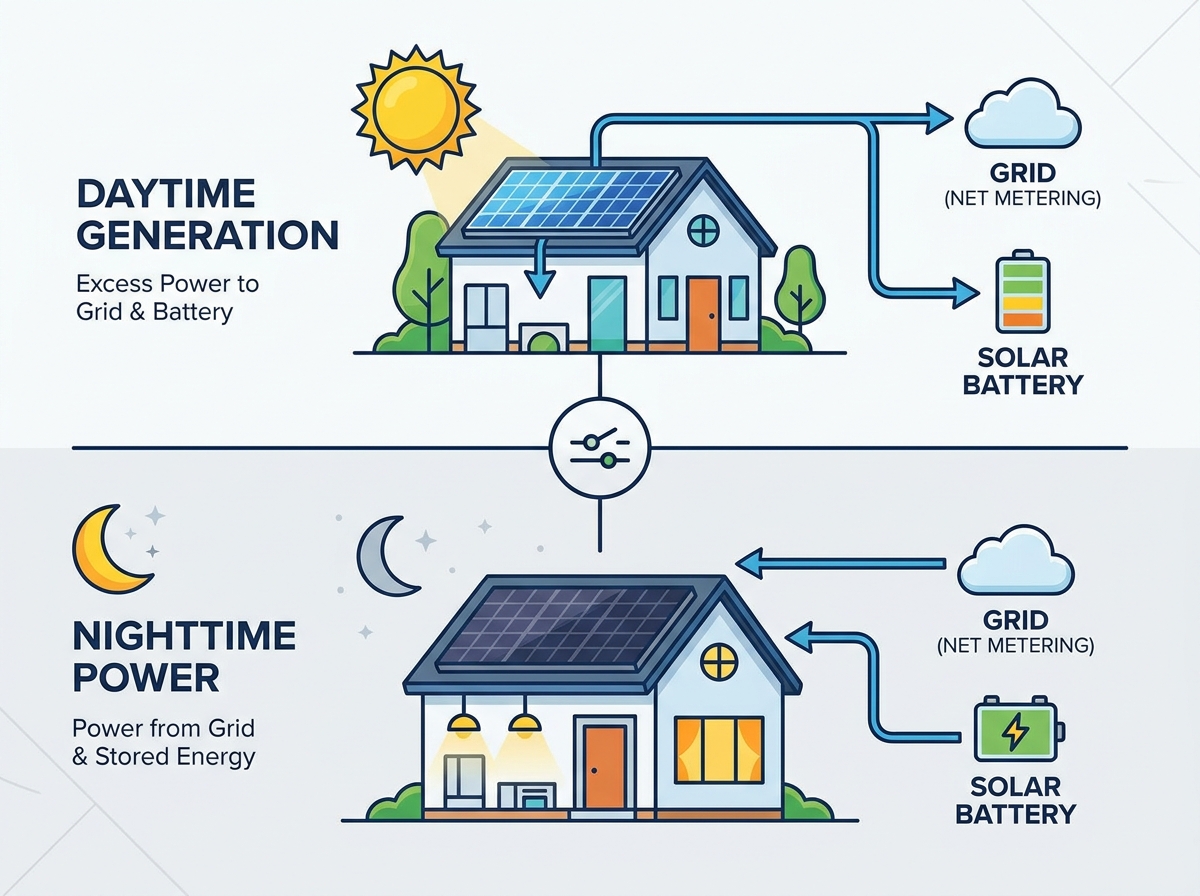
Most residential setups utilize Net Energy Metering (NEM). You can think of the utility grid as a massive virtual battery. Excess daytime production flows backward into the public grid. The utility company logs this export. They give you utility credits in exchange. At night, your home pulls electricity from the grid as usual. You pay for this nighttime usage using your earned daytime credits.
This approach heavily influences your financial return. Grid-tied systems lacking physical batteries cost significantly less upfront. They typically offer the fastest payback period across the industry. This holds true primarily if local utility policies remain favorable. High retail credit rates mean faster daily savings. You essentially swap kilowatt-hours one-for-one. The grid stores your energy without requiring expensive local hardware.
We must highlight a crucial industry shift. Utility policies change frequently. California recently introduced NEM 3.0. This policy severely slashed solar export rates. Many states now shrink generous 1:1 retail credit programs. Wholesale compensation often replaces retail compensation. These shifts alter long-term ROI projections significantly. You cannot blindly assume your utility will always pay top dollar for your daytime surplus.
Grid reliance works best under specific, predictable conditions. You need a highly reliable local electrical grid. Power outages must remain extremely rare in your neighborhood. Your utility company must offer strong net-metering rates. If these factors align, avoiding physical batteries makes the most financial sense.
Compensation Model | How It Works | Impact on Nighttime Use |
|---|---|---|
Retail 1:1 Net Metering | Exported energy equals the retail price of imported energy. | Daytime exports fully cancel out nighttime usage costs. |
Avoided Cost (Wholesale) | Exported energy pays the wholesale generation rate. | Daytime exports only partially cover expensive nighttime imports. |
Time-of-Use (TOU) Metering | Credits vary based on the specific hour of export. | Requires shifting usage patterns to avoid peak evening rates. |
Physical energy storage changes the entire operational paradigm. Excess daytime energy charges a physical on-site battery bank. Leading options include the Tesla Powerwall or Enphase IQ systems. At night, your home discharges the battery first. You pull electricity from the grid only after depleting local storage. This method grants you ultimate control over your energy distribution.
Homeowners choose battery storage for two primary outcomes. We see these goals drive most battery adoption today.
Outcome 1: Energy Resilience. Batteries keep the house running during grid blackouts. The system islands itself from the public grid safely. You maintain critical loads like refrigerators, medical devices, and lighting.
Outcome 2: Rate Arbitrage. Batteries allow homeowners to bypass expensive evening utility rates. Utilities often charge premium Time-of-Use (TOU) prices between 4 PM and 9 PM. You simply run your home off the battery during these expensive hours.
We must acknowledge the high upfront capital expenditure (CapEx). Batteries require significant initial investment. We transparently state an important financial reality. Adding storage extends the break-even point of a solar investment by several years. You trade faster payback for immediate resilience. Battery chemistry also degrades over time. You will likely replace the unit before the panels degrade.
Modular battery systems provide excellent flexibility. They allow homeowners to start with grid-reliance today. You can easily retrofit storage later as your needs change. If your local grid becomes unstable in five years, you simply bolt on a battery pack. You do not need to buy everything simultaneously.
Buyers often misunderstand how grid connection impacts blackout performance. We must clarify the technical differences between system architectures. Safety protocols govern how these setups operate during a power failure.
Standard grid-tied panel systems automatically shut down during a nighttime blackout. They do this for strict safety reasons. This shutdown prevents your system from backfeeding live electricity into broken power lines. Lineworkers repairing those lines could face lethal shocks otherwise. Industry standards like IEEE 1547 mandate this automatic disconnect. Therefore, a standard system goes dark during an outage unless you pair it alongside a battery.
True off-grid systems operate entirely independently. They never connect to the public utility. These setups mandate massive, expensive battery banks. They also require backup diesel or propane generators. This equipment guarantees 24/7/365 continuous operation through winter storms and extended cloudy periods. Off-grid living is rarely the right financial choice for suburban homeowners. We see it utilized mostly for remote cabins or rural agricultural sites.
System Type | Nighttime Power Source | Blackout Protection | Ideal User Profile |
|---|---|---|---|
Grid-Tied (No Battery) | Utility Grid | None (System shuts down) | Suburban homes seeking fastest ROI. |
Grid-Tied (With Battery) | Local Battery, then Grid | Yes (Powers critical loads) | Homes in outage-prone areas. |
Off-Grid System | Massive Local Battery + Generator | Yes (Full independence) | Remote properties lacking grid access. |
Selecting the right nighttime strategy requires a logical evaluation process. You must weigh upfront costs against long-term operational resilience. We built this framework to help you decide.
Choose Grid-Reliance (No Battery) if: You secure 1:1 net metering agreements. You live near highly stable local infrastructure. You prioritize the lowest upfront cost. You want the absolute fastest financial return.
Choose Battery Storage if: You face frequent neighborhood power outages. Your utility company uses aggressive Time-of-Use pricing. Your net metering compensation pays wholesale rates rather than retail rates. You possess critical medical equipment requiring uninterrupted power.
You need concrete data before signing any contracts. We recommend auditing the past twelve months of your utility bills first. Identify your peak consumption hours. Next, check your local municipal net-metering laws. Policies change rapidly, so verify current export rates. Finally, request installation quotes showing dual scenarios. Demand to see the projected return both with and without battery storage. This approach guarantees an evidence-based comparison.
While solar panels sleep peacefully at night, your home's power supply should not. Nighttime electricity management requires proactive infrastructure choices. We rely on the fundamental truth of photovoltaic science. The panels stop producing when the sun sets.
There is absolutely no one-size-fits-all answer for homeowners. The right choice hinges strictly on local utility policy and your personal resilience needs. Grid reliance works wonders in stable neighborhoods. Batteries dominate in outage-prone regions. You hold the power to customize your setup.
Take control of your energy future today. Request a custom system design and projection based on your specific zip code. Analyze your unique energy usage profile to discover your best path forward.
A: Yes. Production definitely drops during overcast weather. Output typically falls to 10-25% of maximum capacity. However, ambient and diffused sunlight still effectively trigger the photovoltaic effect.
A: No. The vast majority of modern residential solar installations remain grid-tied without physical batteries. However, local battery adoption is rising rapidly due to changing utility grid policies and worsening weather events.
A: Only if you have a local storage battery installed. Without a physical battery, a standard grid-tied system automatically shuts off entirely during an outage to protect local lineworkers.
A: The modules themselves do not draw any active power. However, your home's appliances will seamlessly pull electricity from the grid once the inverter detects zero solar production.



